
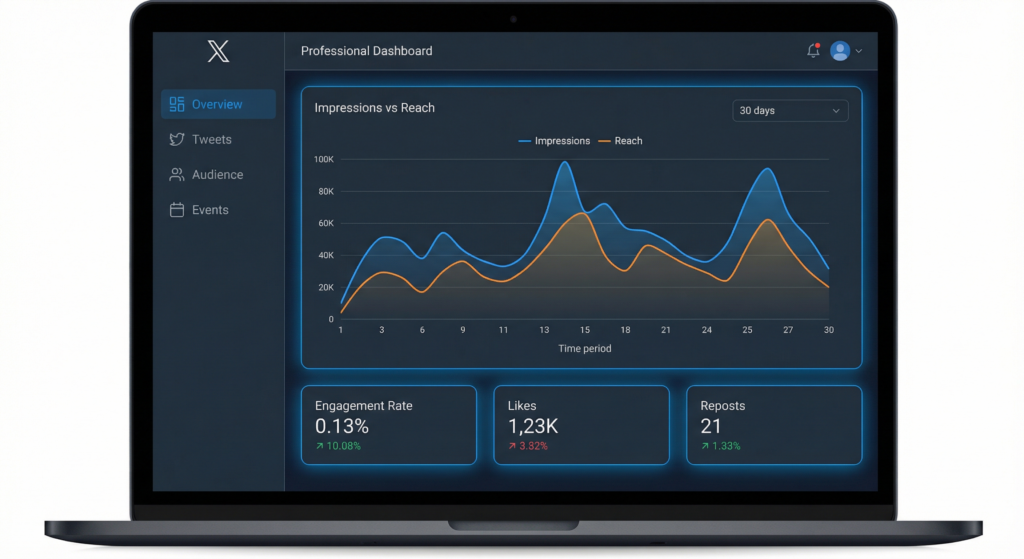
If you’ve ever stared at your X (formerly Twitter) analytics and wondered why your impressions are sky-high while your engagement feels flat, you’re not alone. Two of the most commonly confused metrics on the platform are impressions and reach — and understanding the difference can fundamentally change how you evaluate your content strategy.
In this guide, we break down what each metric means, how X calculates them, and which one you should actually focus on to grow your account.
What Are Impressions on X (Twitter)?
Impressions represent the total number of times a post has been displayed on someone’s screen. This includes:
- Posts shown in a user’s home timeline
- Posts appearing in search results
- Posts shown in reply threads
- Posts embedded on external websites
The key thing to understand: one person can generate multiple impressions. If you scroll past a post three times, that counts as three impressions. X counts every individual display, not every unique viewer.
How X Reports Impressions
X’s native analytics dashboard shows impressions as a cumulative count over a selected time window. For most accounts, the metric resets daily or is tracked over 28-day rolling windows. Premium (X Premium) subscribers get extended analytics going back further.
What Is Reach on X (Twitter)?
Reach measures the number of unique accounts that saw your post at least once. It strips out all the repeat views and tells you: how many distinct people actually encountered this content?
Importantly, X does not natively display a “Reach” figure in its standard analytics — at least not with that label. Instead, the closest approximation is sometimes surfaced through third-party tools or inferred from impression-to-engagement ratios.
Why X Downplays Reach
This is intentional. Impressions give a bigger, more impressive number — which benefits advertisers and keeps users feeling productive. Reach is humbling: it shows you the actual audience size, not the sum of all eyeballs (including repeat ones).
Impressions vs. Reach: Side-by-Side Comparison
| Feature | Impressions | Reach |
|---|---|---|
| Definition | Total times post was displayed | Unique accounts that saw post |
| Counts repeats? | Yes | No |
| Available natively on X? | Yes | Not explicitly |
| Best used for | Total visibility & content volume | True audience size & exposure |
| Inflated by virality? | Yes (each share = new impressions) | Less so |
| Useful for ad campaigns? | Yes (frequency tracking) | Yes (audience coverage) |
Which Metric Should You Focus On?
The short answer: it depends on your goal. Here’s how to think about it:
Focus on Impressions When…
- You’re running paid campaigns and want to measure ad frequency
- You’re evaluating content volume and posting cadence
- You need to benchmark how often your posts show up in feeds
- You’re tracking total platform distribution over time
Focus on Reach When…
- You want to understand your true audience exposure
- You’re measuring brand awareness for unique users
- You’re comparing performance across different content types
- You need to report on unduplicated viewers for a campaign
The Engagement Rate Problem
Many creators make the mistake of calculating engagement rate using impressions as the denominator. This consistently produces lower rates than using reach — because impressions inflate the base number.
For example: A post with 10,000 impressions, 5,000 reach, and 500 likes has:
- Impression-based engagement rate: 500 / 10,000 = 5%
- Reach-based engagement rate: 500 / 5,000 = 10%
Which number you report changes the story dramatically. Most third-party analytics tools use impressions as the default, which makes your content look less engaging than it really is.
How to Get Reach Data on X
Since X doesn’t show pure reach natively, here are your best options:
- X Analytics (native): Look for “Unique impressions” in post detail views (available for X Premium users in some regions)
- Third-party tools: Statweestics, Followerwonk, Hootsuite, and Sprout Social all offer reach approximations
- X Ads Manager: If running paid posts, reach is directly available as a campaign metric
Practical Takeaways for Content Creators
- Don’t chase impressions blindly. A post can get 50,000 impressions from 5,000 people clicking back to it repeatedly — that doesn’t mean your content spread wide.
- Use both metrics together. A high impressions-to-reach ratio means people are seeing your content multiple times — either scrolling past it often or actively revisiting. That’s a signal worth exploring.
- Benchmark against your own history. The most useful comparison is your own trend over time, not industry averages.
- Pair with engagement data. Impressions and reach only tell you about exposure. Combine with likes, replies, and link clicks to understand impact.
FAQ: Impressions vs. Reach on X
Q1: Can my impressions be higher than my follower count?
Yes, absolutely. Impressions count every display, including from non-followers who see your content in searches, trending topics, or retweet threads. A single viral post can generate millions of impressions from far beyond your follower base.
Q2: Does X count impressions if someone doesn’t stop scrolling?
Generally yes. X records an impression when a post appears in the viewport — meaning it was visible on screen — even if the user didn’t pause or interact with it. The exact threshold (how long it must be visible) isn’t publicly documented.
Q3: Why do some posts have low impressions but high engagement rates?
This can happen when a post reaches a very targeted, highly relevant audience. A niche post might get 500 impressions with 100 engagements — a 20% engagement rate, which is exceptional. Narrow reach + high interest = strong engagement rates.
Q4: Are impressions the same as views on X?
They’re closely related but not always identical. X introduced “post views” as a visible counter on posts, which is essentially the same as impressions. The analytics dashboard uses “impressions” as the technical term for the same concept.
Q5: Should I use impressions or reach to report to clients or sponsors?
For sponsorship deals, most brands want both — impressions for reach frequency and total visibility, and unique reach for unduplicated audience size. If you can only share one, share reach: it’s the more honest representation of how many people actually saw the content.

