
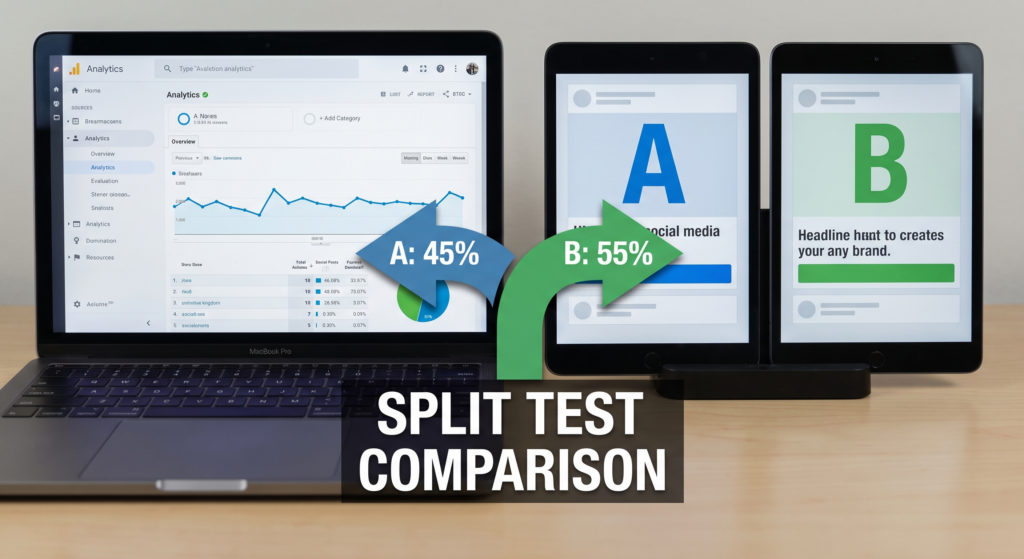
Most social media content decisions are made on gut feel — a topic seems interesting, a format looks good, a headline feels catchy. The problem with intuition is that it doesn’t scale and it doesn’t compound. A/B testing brings the discipline of data-driven decision making to your X content strategy, allowing you to replace guesswork with evidence. The result, over time, is a content engine that consistently outperforms accounts relying on instinct alone.
What Is A/B Testing for Social Media Content?
A/B testing means publishing two versions of similar content with one variable changed — and measuring which version performs better. In social media contexts, this can mean testing different headlines for the same topic, different content formats covering the same idea, different posting times, or different visual styles. The discipline requires controlling for variables (only changing one thing at a time) and measuring with meaningful sample sizes before drawing conclusions.
Why A/B Testing Works on X
X’s public, real-time nature makes it ideal for rapid content testing. Unlike email marketing where you need to segment a list, X exposes your tests to the same pool of followers and non-followers through algorithmic distribution. High-volume posting (3–5+ posts per day) creates enough data points to draw meaningful conclusions faster than most other content channels.
What Makes X Different from Other Platforms
Unlike Instagram or LinkedIn, X’s character limit forces content discipline. A/B tests on X often reveal more dramatically different results because small changes in wording, structure, or format have outsized impact on limited-space content. A one-word change to a tweet’s opening can double or halve its engagement rate.
What to A/B Test on Twitter/X
Not everything is worth testing. The highest-impact variables to test are those that affect whether people stop scrolling and engage with your content at all.
Opening Lines and Hooks
On X, the first sentence is everything. Test different hook styles for the same content: a provocative question vs. a bold statement vs. a surprising statistic vs. a personal story opening. Measure by comparing like-for-like posts on the same topic published at similar times with different opening hooks.
Format: Thread vs. Single Post
Some content ideas work better as a thread; others land better as a punchy single post. Test the same idea in both formats and compare engagement rate, follower growth, and click-through rate (if applicable). Many creators find that threads drive follower acquisition while single posts drive engagement from existing followers.
Content Type: Educational vs. Opinion vs. Story
Test whether your audience responds more to educational how-to content, opinion/take content, or personal story content. These categories often produce dramatically different engagement profiles even when the underlying topic is the same.
Posting Time
Test the same content type at different times of day across multiple weeks. Because time-of-day effects are consistent and audience-dependent, proper time testing requires enough repetitions to control for day-of-week variance.
Visual vs. Text-Only
Does adding an image or chart to a post improve or hurt performance for your specific audience? Test identical text content with and without accompanying visuals across a representative sample of posts.
How to Set Up A/B Tests Properly
Poorly structured tests produce misleading data that can damage your strategy rather than improve it. Follow these principles to ensure your tests produce reliable insights.
Change One Variable at a Time
This is the cardinal rule of A/B testing. If you change the hook AND the format AND the posting time simultaneously, you can’t know which change drove the performance difference. Rigorous testing changes exactly one variable per test.
Define Your Metric Before Testing
Decide what success looks like before you run the test, not after. Are you testing for engagement rate? Follower growth? Link clicks? Reply volume? Different metrics measure different things, and cherry-picking favorable metrics after the fact produces false confidence.
Test with Sufficient Volume
A single post is not a valid A/B test. Run the same test pattern a minimum of 5–10 times across different content topics before drawing conclusions. Pattern recognition across multiple tests is far more reliable than any individual result.
Control for External Variables
Time of day, day of week, and news events all affect content performance independently of your test variable. Run parallel tests on the same day when possible, or run sequential tests with enough repetition to average out external noise.
Measuring A/B Test Results on X
Once you have test data, the analysis step determines whether your testing effort translates into strategic improvement.
Key Metrics for Content A/B Tests
- Engagement Rate: Engagements divided by impressions — the most useful normalized metric
- Impression-to-Follow Rate: How often does a post result in a new follow?
- Reply Rate: Proxy for content that sparks conversation
- Repost Rate: Proxy for content that people want to share
- Click Rate: Essential for posts with links
Statistical Significance
With small sample sizes, apparent differences may be random rather than real. As a practical rule, if Version A consistently outperforms Version B across 8 or more comparable posts by more than 20%, the difference is likely meaningful. For smaller differences or fewer tests, maintain skepticism.
A/B Testing Variables and Expected Impact
| Variable Tested | Difficulty to Test | Typical Impact on Engagement | How Long to Test |
|---|---|---|---|
| Opening hook style | Easy | High (20–100%+ difference) | 3–4 weeks |
| Thread vs. single post | Medium | High (format changes behavior) | 4–6 weeks |
| Posting time | Easy | Medium (10–40% difference) | 4–8 weeks |
| With vs. without image | Easy | Medium (varies by niche) | 3–4 weeks |
| Educational vs. opinion | Medium | High (audience-dependent) | 4–6 weeks |
| Hashtag usage | Easy | Low-Medium in 2026 | 4–6 weeks |
| CTA phrasing | Medium | Medium (10–30% on clicks) | 3–4 weeks |
Building a Testing Culture: The Long-Term Advantage
The creators and brands who compound the most from testing are those who build it into their standard workflow rather than treating it as an occasional exercise.
The Testing Log
Keep a simple testing log — a spreadsheet or Notion document — recording every test: hypothesis, test versions, dates, sample size, results, and conclusion. Over months and years, this log becomes an invaluable record of what works for your specific audience.
Quarterly Strategy Reviews
Every quarter, review your accumulated test results and update your content strategy accordingly. Which hooks consistently outperform? Which content formats drive the most growth? Which posting times maximize engagement? Let data answer these questions rather than refreshing conventional wisdom.
Frequently Asked Questions About A/B Testing on Twitter/X
How many posts do I need to run a valid A/B test?
A minimum of 5–10 comparable posts per variant is a practical starting point. More posts equal higher confidence. Treat early results as directional rather than conclusive.
Can I A/B test ads on X instead of organic posts?
Yes. X Ads Manager has built-in A/B testing features that allow you to test creative variations against each other with statistical rigor. This is easier to control than organic testing and produces faster results if you have an ad budget.
Should I test with my most important content?
Your most time-sensitive or high-stakes content (product launches, major announcements) shouldn’t be the testing vehicle — you can’t afford suboptimal performance in those moments. Test with regular content and apply learnings to important posts.
Does algorithm change affect A/B test results?
Yes. X has made significant algorithmic changes in 2024–2026 that have affected content reach. If you notice broad performance changes across your account, consider whether algorithm updates might be affecting your test results rather than the variables you’re testing.
What’s the biggest mistake in social media A/B testing?
Testing too many variables at once. This is by far the most common mistake, and it renders all test results uninterpretable. Discipline yourself to change one thing at a time, even when it means slower iteration.
Conclusion
A/B testing on Twitter/X transforms content creation from an art into a science — or more accurately, into a disciplined blend of both. You still need creativity to generate compelling content ideas; testing tells you which creative choices resonate with your specific audience. Over months of systematic testing, you’ll build an evidence base that compounds into a content strategy far more effective than intuition alone could achieve. Start simple: pick one variable, test it consistently for a month, and let the data inform your next move.