
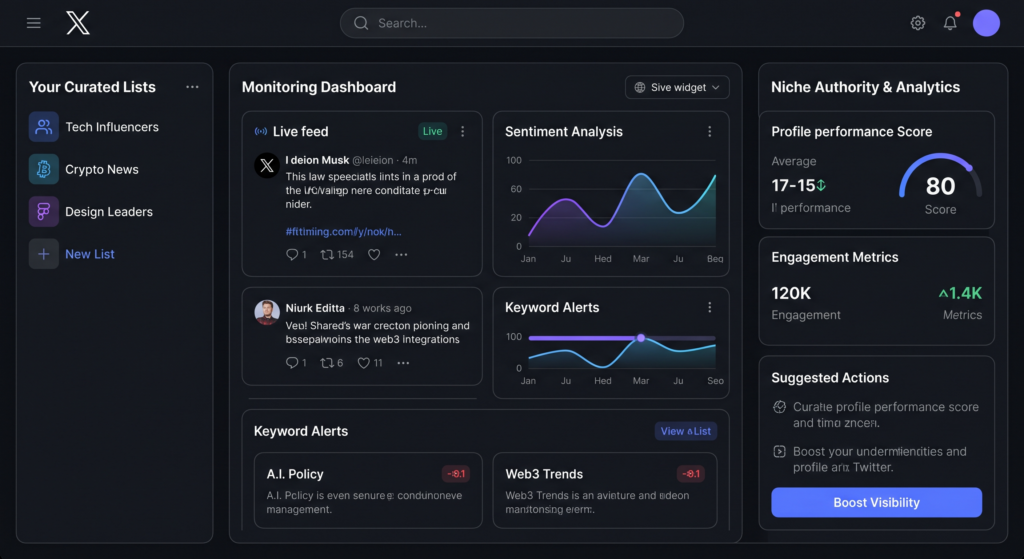
Twitter/X Lists are one of the platform’s most underutilized features — and one of the least analyzed. Most accounts create lists for curation purposes, then never measure whether those lists are actually contributing to growth, engagement, or competitive intelligence. In 2026, with X’s evolving algorithm and increasing noise on the platform, list analytics have become a practical tool for separating signal from signal in your social media strategy.
What Twitter/X Lists Actually Do for Your Strategy
Lists allow you to segment accounts into curated feeds, bypassing the main timeline algorithm. For analytics purposes, lists serve two strategic functions: monitoring (tracking what specific accounts post) and distribution (getting listed by others, which signals authority in a niche).
Being Added to Lists as a Growth Signal
When other accounts add you to a public list, it’s a form of manual curation — they’re telling their audience you’re worth following in a specific context. Tracking how many public lists you’re added to over time is a proxy metric for niche authority growth. A steadily increasing list count correlates with organic follower growth in most categories.
Using Lists to Monitor Competitor Engagement
Adding competitors to a private list and tracking their posting patterns, reply rates, and top-performing content gives you a structured competitive intelligence feed without cluttering your main timeline.
How to Access List Data on X
Native X List Features
X shows how many people have added you to their lists on your profile page under “Listed.” Clicking this shows which public lists include your account. While X doesn’t provide detailed analytics on list membership trends natively, you can track the number manually or through third-party tools.
X API List Endpoints
The X v2 API provides endpoints for retrieving list members, list followers, and tweets from specific lists. Developers can build dashboards that track list membership over time and identify which lists drive the most referral follows.
Third-Party Tools for List Analytics
Tools like Twitonomy, Audiense, and Followerwonk can track list addition history, identify who’s curating you into lists, and analyze the audience overlap between list followers and your own followers.
Key Metrics for Twitter List Analysis
| Metric | What It Measures | Why It Matters |
|---|---|---|
| Listed Count | Total public lists you appear in | Niche authority signal |
| List Growth Rate | New list additions per month | Momentum indicator |
| List Follower Count | How many accounts follow your lists | Distribution reach |
| Engagement from List Feeds | Interactions from list-specific content | Content quality for curators |
| Competitor Listed Count | How many lists include competitors | Benchmarking authority |
Building Lists That Drive Strategic Value
Influencer Lists by Tier
Segment influencers in your niche into nano (1K–10K), micro (10K–100K), and macro (100K+) lists. This lets you track which tier produces the most shareable content, engages most with replies, and aligns best with your audience profile — critical data for partnership decisions.
Customer and Prospect Lists
For B2B accounts, adding current and prospective customers to a private list allows you to monitor their content for engagement opportunities. Engaging authentically with their posts before outreach significantly improves connection rates.
Topic-Based Content Curation Lists
Building public lists organized by topic (e.g., “AI Tools for Marketers” or “SEO Strategy”) positions you as a curator in your niche. When others follow your lists, it extends your influence beyond your direct followers.
How List Analytics Inform Content Strategy
Identifying Top-Performing Content in Your Niche
By monitoring competitor and industry lists, you can identify which content formats and topics generate the most engagement within your niche — before investing time creating similar content yourself.
Finding Collaboration Opportunities
Accounts that appear on multiple industry lists are well-established in their niche. Tracking which accounts show up repeatedly across lists you follow or belong to surfaces natural collaboration candidates.
Timing Insights from List Monitoring
Watching when top-performing accounts in your niche post and measuring their engagement by time of day — over weeks of list monitoring — gives you empirical data on optimal posting windows specific to your niche audience.
Common List Analytics Mistakes to Avoid
Ignoring Private List Limits
X limits accounts to 1,000 lists with 5,000 members each. Heavy list users who don’t audit and prune regularly hit these limits, which prevents adding new high-value accounts.
Not Tracking List Growth Over Time
Checking your listed count once tells you nothing. Monthly snapshots over 6–12 months reveal whether your authority in the niche is growing, plateauing, or declining — each of which signals different strategic responses.
Frequently Asked Questions
Can I see who added me to a list?
Yes. Click “Listed” on your profile, and you’ll see all public lists that include your account, along with the list creator’s name. Private lists are not visible to you.
Do list followers count as my followers?
No. List followers are users who follow your list, not your account. However, list followers are exposed to your content through the list feed, which can drive profile visits and follower conversions.
Is there an analytics tool specifically for X Lists?
Audiense and Twitonomy offer the most comprehensive list analytics. The X v2 API also allows custom dashboards with deeper data if you have developer access.
How many lists should I be monitoring actively?
Most strategic accounts maintain 5–15 active monitoring lists. Beyond that, the volume of posts becomes difficult to review meaningfully without automation.
Can competitors see my private lists?
No. Private lists are visible only to the list owner. The accounts on a private list are not notified and cannot see the list.
How do I get added to more lists?
Consistent posting in a specific niche, engaging authentically with list curators, and making it easy for others to identify your expertise (clear bio, focused content) all increase list addition rates.
Conclusion
Twitter/X list analytics are a low-cost, high-signal tool for measuring niche authority, understanding competitive dynamics, and finding collaboration opportunities that direct follower metrics miss. By tracking your listed count over time, building strategically organized monitoring lists, and using third-party tools to enrich native data, you can turn one of X’s most overlooked features into a genuine strategic asset. Start by auditing your current listed count and the lists you’re actively monitoring — then build from there.